‘Four Seasons Of Love’: Donna Summer’s Year-Round Soul Affair
After her ‘Love To Love You Baby’ breakthrough came Donna’s fourth studio album ‘Four Seasons Of Love.’
Published on October 11, 2020
By Paul Sexton
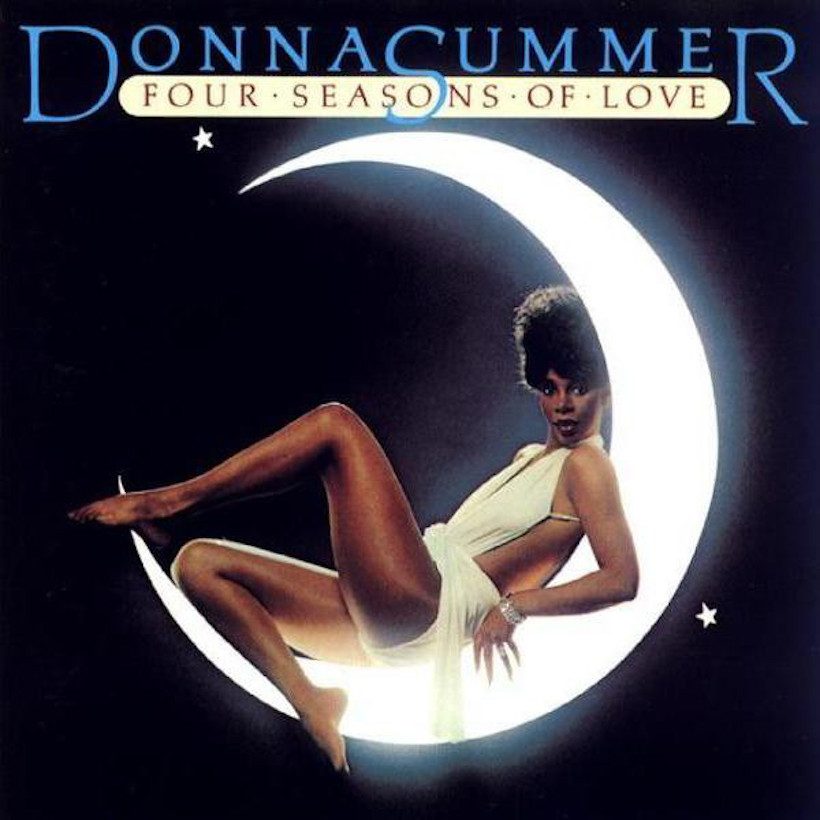
In October 1976, the new album release schedule wasn’t just about Donna Summer, but spring, autumn and winter too. As the Boston-born artist continued her popularity in the wake of her “Love To Love You Baby” breakthrough, her fourth studio album Four Seasons Of Love was released on October 11 that year.
Listen to Four Seasons Of Love right now.
Four Seasons Of Love reached only No.29 on the American album chart, but spent six months there. Like its two forerunners, it also went gold and further enhanced Donna’s reputation as one of the most creative artists working in the burgeoning disco scene. The next time she returned, it would be with the song that defined that entire era, “I Feel Love.”
Published on October 11, 2020
By Paul Sexton
In October 1976, the new album release schedule wasn’t just about Donna Summer, but spring, autumn and winter too. As the Boston-born artist continued her popularity in the wake of her “Love To Love You Baby” breakthrough, her fourth studio album Four Seasons Of Love was released on October 11 that year.
Listen to Four Seasons Of Love right now.
This album features the girl-group-sounding backup vocals of her 3 girlfriends, Madeline Bell, Yvonne Wheatman and her sister Heather Wheatman, under the 2 stage names, "Sue Glover & Sunny Leslie".
Her controversially sensuous debut hit of 1975 established the singer’s working relationship with her co-producers and writing collaborators Giorgio Moroder and Pete Bellotte. The Love To Love You Baby album went gold, following its eponymous smash into the Top 10, and was followed early in 1976 by the ambitious, conceptual A Love Trilogy.
Magic at Musicland
That second album, like its predecessor, was created at the producers’ Musicland Studios in Munich, soon after the first set. It was distinctly divided into movements, with the whole of side one being taken up with the 17-minute “Try Me, I Know We Can Make It.” The second side included Summer’s version of Barry Manilow’s “Could It Be Magic,” which she turned into a disco and pop bestseller.
After a brief respite from recording, most of which the artist needed for promotion of her new-found stardom, the team returned to Musicland in the middle part of 1976 to make Four Seasons Of Love. This time, the concept was the telling of a love story by the seasons, hence the titles “Spring Affair,” “Summer Fever,” “Autumn Changes” and “Winter Melody,” with a closing “Spring Reprise.”
That second album, like its predecessor, was created at the producers’ Musicland Studios in Munich, soon after the first set. It was distinctly divided into movements, with the whole of side one being taken up with the 17-minute “Try Me, I Know We Can Make It.” The second side included Summer’s version of Barry Manilow’s “Could It Be Magic,” which she turned into a disco and pop bestseller.
After a brief respite from recording, most of which the artist needed for promotion of her new-found stardom, the team returned to Musicland in the middle part of 1976 to make Four Seasons Of Love. This time, the concept was the telling of a love story by the seasons, hence the titles “Spring Affair,” “Summer Fever,” “Autumn Changes” and “Winter Melody,” with a closing “Spring Reprise.”
“Spring Affair,” the first single, faltered on the US pop chart, reaching only No.58, and peaked at No.24 on the R&B countdown. “Winter Melody” was somewhat more successful, chiefly with the adult contemporary audience, on which chart it went Top 10. It also gave Summer a new Top 30 hit in the UK.
Four Seasons Of Love reached only No.29 on the American album chart, but spent six months there. Like its two forerunners, it also went gold and further enhanced Donna’s reputation as one of the most creative artists working in the burgeoning disco scene. The next time she returned, it would be with the song that defined that entire era, “I Feel Love.”
Tracklist
A1 Spring Affair 8:32
A2 Summer Fever 8:08
B1 Autumn Changes 5:30
B2 Winter Melody 6:30
B3 Spring Reprise 3:53
Companies, etc.
Phonographic Copyright ℗ – Casablanca Records, Inc.
Copyright © – Casablanca Records, Inc.
Recorded At – Musicland Studios
Lacquer Cut at – Allen Zentz Mastering
Pressed By – Columbia Records Pressing Plant, Santa Maria
Credits
Accompanied By – The "Munich Machine"*
Arranged By – Thor Baldursson
Art Direction – Chris Worf*
Art Direction, Design – Gribbitt*
Bass – Les Hurdle
Design – Henry Vizcarra
Drums, Percussion – Keith Forsey
Mixing Engineer – Giorgio Moroder
Recording Engineer – Juergen Koppers*
Guitar – Nick Woodland
Keyboards, Strings, Horns – Thor Baldursson
Lacquer Cut By – Brian Gardner
Lead Vocals – Donna Summer
Costume Design – Julio Martinez
Make Up – Pierre Laroche
Photography By – Mario Casilli
Producer – Giorgio Moroder, Pete Bellotte
Saxophone – Dino Solero*
Synthesizer – Geoff Bastow
Notes
Recorded in MusicLand Studios, Munich ; August / September 1976, An Oasis Recording.
LP housed in lyric sleeve with "For More Love From The First Lady" advert on rear showcasing "OCLP 5003 & OCLP 5004" LP's.
℗ © 1976 Casablanca Records Inc.
"AZ" in the deadwax etchings indicates the lacquer was cut at Allen Zentz Mastering
"❀" in the deadwax etchings indicates the lacquer was cut by Brian Gardner
"CSM" & "1S" in the deadwax etchings indicates the disc was pressed by Columbia Records Pressing Plant, Santa Maria
Barcode and Other Identifiers
Matrix / Runout (Side A Label): 7038-A
Matrix / Runout (Side B Label): 7038-B
Matrix / Runout (Side A (Var 1) Runout): 1 NBLP-7038-A-11-CSM AZ❀ A8
Matrix / Runout (Side B (Var 1) Runout): 1S S NBLP-7038-B8-CSM AZ❀ B7
Matrix / Runout (Side A (Var 2) Runout): NBLP-7038-A8-CSM AZ❀ 1S
Matrix / Runout (Side B (Var 2) Runout): NBLP-7038-B11-CSM AZ❀ 1S
Comments
Post a Comment